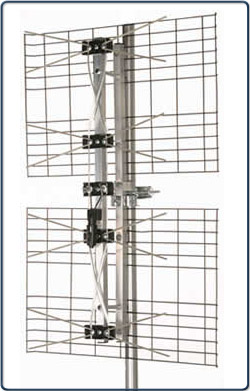
And just why would you want to go back to the old days and connect to an outdoor antenna? It just may give you better picture quality on your high-definition (HD) television. More and more local television channels are broadcasting in HD. But you say you already have cable or satellite. Great! The problem might be that the satellite provider or the cable TV company may compress the signal before sending it to you, giving you a poorer picture. And they may charge an additional fee for local channels. An outside antenna with the right technology will give you local HD broadcasts that are not compressed and it is free.
You may not really care about HD television. You may be perfectly happy with analog (old fashion) broadcasts on your current TV. It won’t be long and you won’t have a choice. The United States government is requiring all broadcasters to switch to digital by February 2009. That isn’t all that many page turns on the calendar.
The pictures you get, or will get on an HD television with an antenna will be great. If you aren’t aware of digital technology, you don’t get a weak, fuzzy or snowy signal. You either get a flawless signal or none at all, just a black screen. There would be no snow like you sometimes got years ago from your old antenna and analog signals.
So if you get either a perfect picture or no picture, why not just use rabbit ears? Good question. You can. Rabbit ears, or other inside antennae, tend to work just fine…if you are within 25 miles of the local station’s broadcast facility. Typically you should expect an outside antenna to capture signals from about 70 miles away, depending on what is in between you and the broadcast tower. Mountains and prisons are two great signal blockers, for example.
You may be wondering how an outside antenna can possible give you a better quality than cable, if you are like many others. We think that way, or we wouldn’t have joined up with cable or satellite in the first place. Your cable or satellite provider needs to provide you with many HD channels or choices. They have to make sure there is room for all of those choices. To make sure there is room they sometimes compress, or remove, a certain amount of data from the signal you end up with at your television. Your local HD broadcaster doesn’t care about providing space for other broadcasters. In fact, they would be perfectly happy if you simply watched their station only. There is no data removed, no signal compression.
If you are an ESPN, CNN, History Channel, Disney Channel, or Weather Channel junkie, you won’t be capturing them with just an antenna, inside or out. You can add an antenna as a signal source to your cable or satellite system and, for a small price, enjoy the ultimate your local broadcasters have to offer, along with the other channels you are addicted to.
If you decide you want to try either an indoor or outdoor antenna for HDTV, they range in price from about $20 to $170. You can also try making your own. It isn’t that difficult and would save you even more money.
No matter if you are interested in HDTV or not, the time is coming when you won’t have a choice. An antenna may be your answer. Even if it isn’t, they are cheap enough or easy enough to make yourself that you can test the performance out before you make a final decision.
Once again, what is old is made new.
Michael Russell Your Independent guide to Antennas
Article Source: http://EzineArticles.com/?expert=Michael_Russell
The New Old-Fashioned Antenna

Just When You Thought TV Antennas were a Thing of the Past
Many experts including myself are convinced TV antennas are the new wave of the future. Why? Because at this time nearly every broadcast TV station in the United States is now available in crystal clear digital HDTV and best of all it's free. All you need to enjoy your favorite programs in picture perfect high definition is an HDTV set with a digital tuner and a TV antenna.
The best possible HDTV pictures come from those you get using a TV antenna. Snowy pictures and poor sound quality are a thing of the past. With digital HDTV broadcast television you'll enjoy crystal clear life like pictures and CD quality Dolby surround sound, along with many more channels to choose from, all provided to you free of charge by your local broadcasters.
The nature of digital broadcasting allows each broadcaster in your area to provide up to six channels where there once was one analog channel. In other words digital broadcasting makes it possible for your local broadcasters to provide you with up to six times as many channels. Many areas of the country now have dozens of channels available, free for the watching.
The average American households spends more than $60.00 a month for pay TV. Whether or not free digital broadcast television will replace your current cable or satellite TV is strictly a personal choice. Digital television along with the rising cost of pay TV has many people dropping their pay TV, installing a TV antenna and eliminating their monthly cable bill altogether.
If you choose to keep your pay TV provider the addition of an over the air TV antenna to receive free digital TV is still likely to be in your future. In most areas pay providers offer you just a fraction of the local channels that are available with a TV antenna. They choose the channels you get, charge for what they do offer, and most of what they offer is of poorer picture and sound quality when compared to over the air digital TV. Last but not least, when your cable or satellite goes out, and it will, you'll still have your digital broadcast channels.
I'm not saying you should do away with your pay TV provider. I have satellite TV in my home, we use and enjoy it. Too many people think it's an either or decision when it comes to pay TV or a TV antenna. The truth is, a TV antenna system compliments pay TV and vice versa. Its not your pay TV providers fault they can't offer you all the local channels that a TV antenna can. In many cases Federal law prohibits pay TV providers from broadcasting many of these channels.
With the introduction of digital HDTV the benefits free over the air TV can offer are tremendous. I think the following statement released by an industry spokesperson says it best. "Thanks to over the air digital broadcasting, we can broadcast data which will revolutionize the way you communicate, entertain yourself and live your live. We will be able to marry the convenience of television with the freedom and power of the internet. Datacasting wiil make truly interactive TV possible, empowering the viewer to make television viewing an incredible experience.
Denny is considered to be an expert in his field. He has been installing TV antennas for nearly twenty years. His website TV Antenna Source at www.dennysantennaservice.com is full of helpful tips and useful information for the do-it-yourself TV antenna installer.
Article Source: http://EzineArticles.com/?expert=Dennis_Duplessis
Antenna Boosters For HDTV
Got a choppy HDTV signal? So you are watching on tv your favorite basketball team playing for the championships but suddenly the tv signal has gone wild. You stand up and fix the antenna. You try switching it on and off hoping that you can retrieve the channel. But then your effort is to no avail.
Your tv antenna has failed to pick up a strong signal probably because your home is far from the signal tower or there is something that hinders your tv antenna from getting a strong signal as emitted by the signal tower. There is a solution to that.
Why not get a tv antenna booster? The tv antenna booster will surely allow you to watch your favorite shows on tv without the worry of losing that channel again.
Before you get a tv antenna booster though, you must first know the kind of antenna which your tv possesses. Here are the basic types of tv antennas and some significant terms to take note of.
The HDTV Antenna
For a better understanding, there is no big difference between the antenna used for the HDTV as well as with the DTV. Some of the most unscrupulous personas in the marketing industry made a fallacy out of these antennas for the sake of getting their products ranking first that the rest of the competitors. This issue has greatly affected the honest antenna producers and they had to re-label their products to avoid losing their income.
In connection with the HDTV antenna, there are a couple of important terms that you must familiarize yourself with. Gain refers to the quantity of the signal that the antenna will be collecting. Beam width is all about how directional the antenna can be. Lastly, bandwidth refers to the manner of how the gain differs with the frequency. This emphasizes that a narrowband antenna can receive more channels clearly while some channels may appear vague.
The Dipole Antenna
The Dipole is the simplest antenna used for the tv. The variants of the dipole antenna include the bow tie that contains a wider bandwidth with it, the folded-dipole which is able to solve any problem on efficiency, and the loop which is one type of the folded dipole. All of these kinds possess the same amount of gain and the same pattern on the radiation.
The dipole antenna has with it a positive gain since it does not equally radiate towards all directions. As the general truth goes, a tv antenna should radiate in very few directions. In the United States, the tv antennas are usually placed horizontally. That is why no signal will be picked up by the tv antenna if it is placed in a vertical manner.
The Reflector Antennas
Reflector antennas function by means of the radio waves which are reflected off from a conducting plane. The reflector antennas are common to utilize the double bow-tie variant since it contains a large bandwidth.
The Yagi Antennas
The elements in a Yagi antenna are arranged on an echelon. There is the boom which is a long element that serves to connect all of the parts. There is no current contained in the boom. Since the boom is an insulator, the antenna likewise carries on the same function. The reflector is the rearmost element in the Yagi antenna.
The other element is known as the driven element and the rest of them are termed as directors. Of all the types of antennas, the Yagi antenna is said to be the most magical.
After knowing the type of antenna you've got, you can now start your search for the most appropriate HDTV antenna booster to use. Your choice ranges from the MG 950, MG1090, MG 952, MG 825, and many more.
Before you go and throw your remote through the tv screen in frustration why not find out all about the HDTV antenna? There is more to it than just plugging the cord into the wall and expecting the TV to perform to the best of it's ability, check out the data for HDTV info here.
Article Source: http://EzineArticles.com/?expert=Steve_Knowles
Over the Air HDTV Antennas
One of the essential components you will need for an HDTV system is an antenna. You will see many advertisements for HDTV antennas but be aware that in many cases the same antenna would work for any digital television system; the most important features of an antenna is that gain, F/B ratio and directivity. These are the specifications that are most important to ensure clear reception on both digital and analog broadcasts.
Making the decision to purchase an HDTV system is becoming increasingly more difficult to postpone as broadcasters prepare to make the transition to the analog signal broadcasting behind to deliver their programming in high definition resolution. Owners of analog television sets can convert them to be able to receive digital signals but the cathode ray tube technology have a hard time competing with the resolution of an plasma or LCD monitor.
Surprisingly, “Over The Air” (OTA) antennas provide reception quality equal to and in some cases better than satellite or cable.
The first step in purchasing an antenna for your HDTV system is to make sure that you have a built in tuner. Many digital television sets on the market are being sold under the labels of "HDTV-ready". These DTV sets are able to receive high-definition video from a satellite or cable receiver but are not able to receive the signals from over the air broadcasting because they do not have a tuner. On a DTV set without a tuner the OTA HDTV broadcasts cannot be decoded into visual images and sound.
To determine whether or not the DTV has a built-in tuner simply look to see if there is an “RF antenna connector” at the back of the television set. A DTV set with a built -in tuner must have a connector to plug in an off air high-definition antenna.
There are outdoor and indoor antennas you can use:
An outdoor directional antenna receives high-definition signals from a longer range and must be aimed in a particular direction. This type of antenna is ideal if the source of your broadcasting signal is in the same direction from your location.
An indoor directional antennas but the reception is not as stable as the outdoor models. An amplified indoor antenna may give you better reception but in most cases an outdoor HDTV antenna is your best option for reliable reception. Make sure the cables are connected properly and the antenna is aimed in the right direction.
Many times the reception problem with the antenna is that the directivity or gain is too low to pick up the signal. The antenna is the least expensive component for your HDTV system, but it plays a crucial role in its enjoyment. In most cases you will be able to purchase a good-quality antenna for under $100.
Consumers need to be aware of how the various components of the HDTV system work and what their capabilities need for the best performance. Shopping for an HD TV system with factual information will prevent confusion and will make you resistant to the HDTV hype that surrounds this technology and electronics being manufactured for it. Make sure to discuss the features of the antenna for your HDTV system with a salesperson and compare the directivity and gain of the best models before you buy.
HDTV Antenna is one of the things you should look at when upgrading your television system, learn more about High Definition Television at http://hdtvmainhub.com
Article Source: http://EzineArticles.com/?expert=Brad_Hamill
Here is What You Need To Be Able To View HDTV
Well of course, the first component needed is the HDTV signal which is sent from a source like a cable or satellite provider, or a local broadcast station. It takes more advanced and expensive equipment to be able to broadcast a HDTV signal instead of the old analog signal that has been used for many years. But the FCC has mandated that by the end of 2006 all broadcasts will have to be available in HDTV, so it won't be long before HDTV will be the defacto standard for sending and receiving TV signals. In fact, most of the major cable and satellite companies already offer significant HDTV programming options at this point.
Now that there is a HDTV signal being sent you will need a HDTV "enabled" or "ready" television to be able to receive that signal and display it correctly. If the TV is "HDTV enabled" that means that it does not have a HDTV tuner already built into it but can display HDTV programming if a HDTV tuner is hooked up to it. If it is "HDTV ready" it has the HDTV tuner and is capable of receiving HDTV signals right away. So what is the difference for you?
Well, most satellite and cable companies will only allow you to use their proprietary tuner to gain access to their programming on your TV set, so they essentially bypass the tuner that is in the TV. If you have a HDTV enabled set, this is no problem because it is able to receive and display in HDTV using the tuner from the satellite or cable company. If you have a HDTV ready set, it is still no problem, but if you paid extra for the tuner, you may not be able to get much use from it if you view satellite or cable programming all the time. However, if you are not able to get local channels by satellite or cable, having a HDTV tuner can allow you to receive those channels and display them in HDTV with an appropriate antenna.
So when you look for a new television, be sure to have in mind what your needs will be regarding programming. If all of your viewing will be done through a cable or satellite provider there may be no need to get a TV set that has a HDTV tuner built in. It just has to be HDTV enabled and ready to process a HDTV signal when a HDTV tuner is attached to it. On the other hand, if you will be receiving your broadcasts by antenna or over the air, then you will definitely need the built in HDTV tuner to receive and display HDTV programming.
Just doing a little advance planning can help you buy only the equipment that you will need to view HDTV.
Jim Johnson writes on many consumer related topics including HDTV. You can find out more about hdtv tuners by visiting our HDTV and Television Review website.
Article Source: http://EzineArticles.com/?expert=Jim_Johnson
How Do You Know The Best HDTV Antenna For You?
Since HD technology is so new, most people don’t realize that you don’t have to go buy a whole bunch of new technology to get HD, including the best HDTV antenna. You don’t even have to be a cable or satellite TV subscriber to get the best local shows that are shown in HD by broadcast networks. All you need to do is figure out the best HDTV antenna for your area, and with a HD-ready television, you’ll be ready to go.
So, how do you know what is the best HDTV antenna? There is a nifty website set up to answer that question for you. It is called antennaweb.com, and it serves as a one stop shop for all of your HDTV antenna needs. The way it works is, you visit the site and there is a search engine set up for your particular area. You enter in your address, what floor you live on and if there are any blockages in your way, and it will tell you the best way for you to get HDTV with an antenna.
For some people, a simple indoor, TV-top antenna will work just fine. The Philips USA PM-HDTV1 HDTV/UHF Digital Indoor Antenna is a good example of a high-quality indoor HDTV antenna. This model sells on Amazon.com for as little as $20.00. There are many more models of antennas out there, but this is a quality model.
Using Orlando, Florida as a test area, Antenna Web suggests that a medium directional antenna will get you almost every digital signal in the area. The site is very useful and extremely customizable to take things like trees, the floor you live on and buildings that might be in the way into consideration.
There is also a comprehensive breakdown of the channels you can get with each different kind of antenna. If there is only one particular channel you’re looking to get with your HDTV antenna, then you can simply look to see what type of antenna you’ll need for that one station, instead of getting a larger and more expensive antenna to get all of them. If you do want to get all of them and you live in a crowded area, you might need an outdoor antenna model, many of which are made by RCA.
Figuring out the best antenna to get HDTV can be tough, but with this great guide, finding out how to get HDTV without cable or satellite is easy as pie.
Dean Iggo is the webmaster of a hdtv reviews website where you can find reviews of the most popular brands including the Panasonic hdtv, Pioneer, Sony, LG and more.
Article Source: http://EzineArticles.com/?expert=Dean_Iggo